


| Magic Series | Formulae |
| Number N(n, m) of magic series for hypercubes of dimension n and order m |



| The formulae for small orders m and random dimensions n |
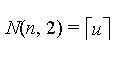
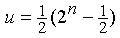
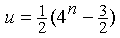
| Order m = 2 | |
|
|
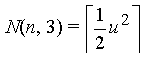
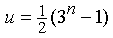
| Order m = 3 | |
|
|
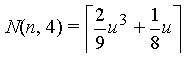
| Order m = 4 | |
|
|
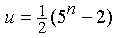
| Order m = 5 | |
|
|
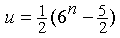
| Order m = 6 | |
|
|
| Orders 7 to 11 |
| The first coefficients of the formulae |
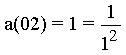
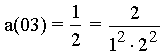
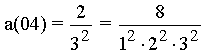
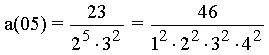

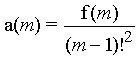 with the numerator f(m).
| The sequence of the numerators |
| 1; 2; 8; 46; 352; 3364; 38656; 519446; 7996928; 138826588; ? |
| ...; 2683604992; 57176039628; 1331300646912; 33636118326984; 916559498182656; ... |
|
"All this is the proof that your coefficients are 100% correct and that they have a strong mathematical basis. But... it will be perhaps difficult to explain WHY this sequence and formula is used for hypercubes." |
| Cloître's sequence: |  |
| The surprising proof |
|
"I think I have now actually found a proof, for the case that m is even, that N(x,m) is indeed a quasi-polynomial
of degree m-1 in x, and that its coefficient of degree m-1 is indeed equal to f(m)/(2^(m-1) (m-1)!^2 ),
where f(m) is the m-th term in the sequence defined in OEIS A099765. My proof is based on geometric concepts, and in my mind it gives a clear geometric interpretation of all the terms and factors appearing in the expanded formula (with f(m) = the summation formula given in OEIS A099765). I also prove that, for the case that m is even and m≥4, the period L(m) of the quasi-polynomial N(x,m) in x is a divisor of l(m-1), where l(n) is the least common multiple of the first n natural numbers (1,2,…,n). All this seems to be true if m is odd as well, but adaptations of the current proof would certainly be necessary, if at all possible." |
| What about the other coefficients? |
| Approximation of N(n,m) for high orders m and dimensions n |
| Thus we get good approximations of N(n, m) by just calculating the first summand of the affiliated formula. |
| Let's speak about 'm1-approximation' (First Member Approximation). |
| ⇒ N(100,100) = 1.47857923327431013915144303218931705714497824542031... · 1019641 |
| Comparisons in dimension n=2 |
| Method | m = 10 | m = 100 | m = 1000 | m = 10000 |
| Gerbicz, Kinnaes (exact) | 78132541528 | 9.0430074 · 10236 | 6.5918292254 · 103424 | - |
| Bottomley (approx.) | 78120036444 | 9.0430064 · 10236 | 6.5918292275 · 103424 | 2.945158 · 1044330 |
| m1-approximation | 78371381680 | 9.0466982 · 10236 | 6.592103 · 103424 | 2.945170 · 1044330 |
|
The table confirms the different methods impressively. |
| Magic series for cubes (n=3) |
| For example: N3(100) ≈ 1.4713509428 · 10435 (Expected relative error < 10-10 ) |
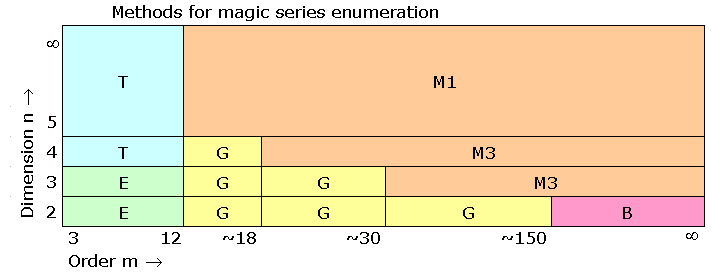
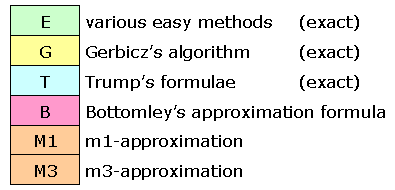
| Overview |
| Back to the Table of Contents |